

This week, our youth group watched a video of Bishop Rob Hirschfeld speaking at the vigil for Renee Good, who was shot and killed by ICE in Minnesota. The Bishop’s remarks have sparked controversy among Christians and clergy alike.
“we are now, I believe, entering a time, a new era of martyrdom…I have told the clergy of the Episcopal Diocese of New Hampshire that we may be entering into that same witness. And I’ve asked them to get their affairs in order—to make sure they have their wills written, because it may be that now is no longer the time for statements, but for us with our bodies to stand between the powers of this world and the most vulnerable. And it may mean that we are going to have to act in a new way that we have never seen perhaps in our lifetime…to put our faith in the God of life, of resurrection, of a love that is stronger than death itself.”
At the heart of his remarks is a central question: what does it mean to stand in solidarity with the poorest, most vulnerable, and most oppressed people in our communities and in the world? Are we willing, as Christians, to risk everything—perhaps even our lives—to stand in that solidarity?
Being a Christian right now is difficult. It can be hard to discern what it means to live as a follower of Jesus when even those within our own faith are so deeply divided. What does it mean when people who profess to follow the liberator of the oppressed—who calls us to welcome the stranger—are the same ones using military-style force to deport families and children, broadcasting it across news stations as a theatrical spectacle?
It was members of our youth group, some of whom belong to various marginalized communities, who were quick to point out that the violence and oppression unfolding in the United States are also beginning to take hold here at home in Canada. They noted that fear-based rhetoric targeting transgender and disabled people has entered the language of Canadian politicians, and they spoke honestly about their fear that what is happening to our neighbors to the south could just as easily happen here.
I sit with all of this as we prepare to begin another Week of Prayer for Christian Unity—a celebration that began in the Catholic Church in 1908 and has since spread across many denominations, including our own. This year, I feel a deep sense of urgency for Christians around the world to raise our voices against hatred, fear, and oppression. That work begins in prayer, and prayer must then lead us to action.
It feels like a profound blessing that here in West Hamilton we have churches such as St. Cuthbert’s Presbyterian, McNeil Baptist, and St. Paul’s Anglican that have long worked together with our own community of faith at Westdale United. I am especially encouraged that each year more and more churches choose to participate in the Week of Prayer for Christian Unity service. It speaks to a broader desire across denominational lines to reclaim the unifying heart of our faith—so that together we might pray for, and help bring about, God’s reign here on earth.
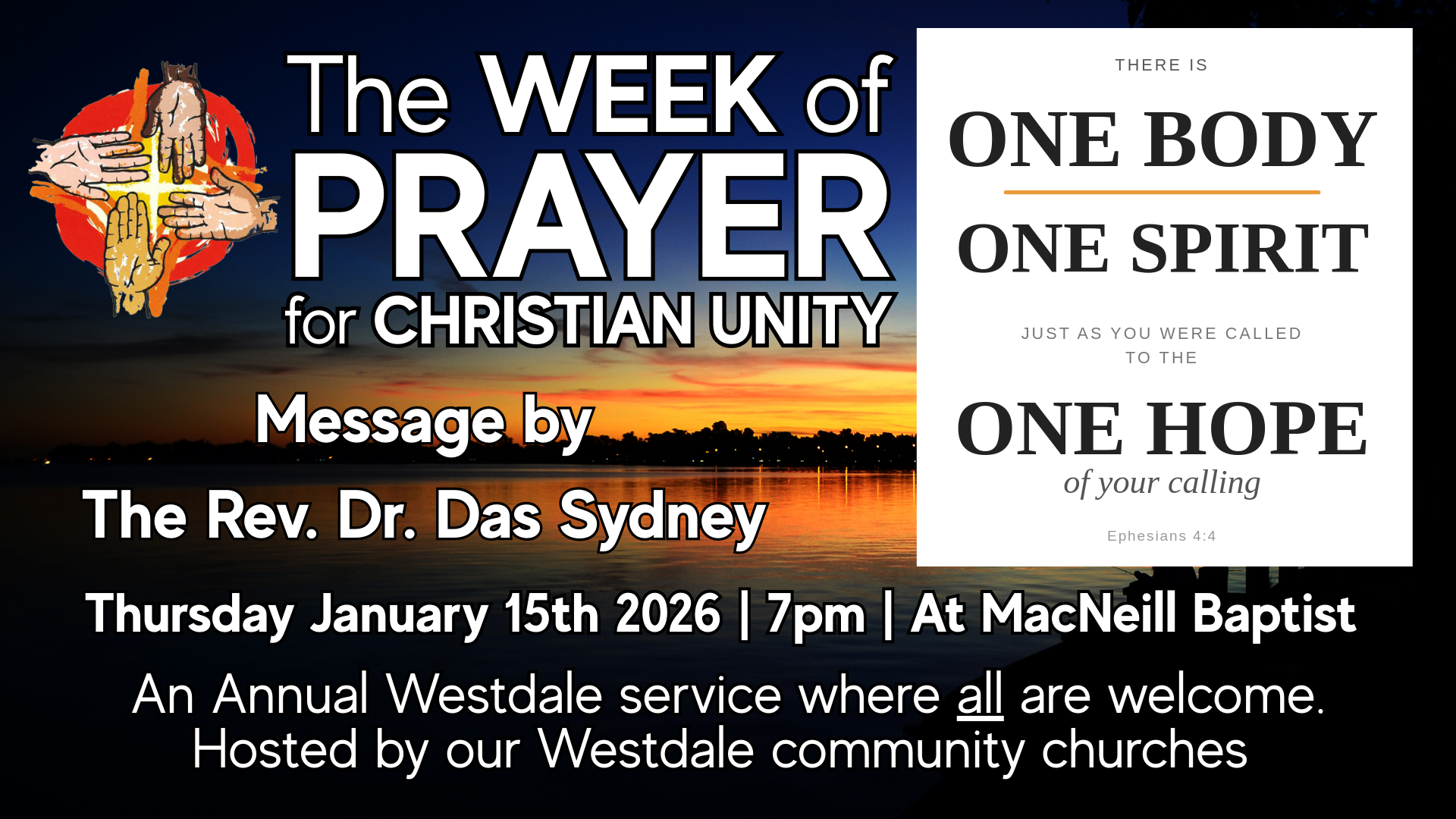
With this in mind, I hope you will take the time to join us for the annual Week of Prayer for Christian Unity service, happening this Thursday at 7:00 p.m. and hosted by McNeil Baptist Church.
Our guest speaker will be the Rev. Dr. Das Sydney. Das Sydney was born in India, grew up in Africa, and had his university education in Ghana, Canada and the U.S. He is the Past-President of the Canadian Council of Churches and a past president of the Canadian Baptists of Ontario and Quebec. He has served as an adjunct at Acadia Divinity College and McMaster University. He is the Minister Emeritus of Highland Baptist Church and serves on the Board of Directors of “Indwell,” which offers supportive housing for vulnerable populations. He is married to Angela, and they have three adult children and six grandchildren. He was recently awarded the King Charles III Coronation medal.
As we gather this week, we do so not because we have all the answers, but because we trust that God meets us when we show up together. In a time marked by fear, division, and very real threats to human dignity, Christian unity is not a polite ideal—it is a faithful response. To pray together is to remember who we are and whose we are; to stand together is to practice the kind of love that refuses to look away from suffering. My hope is that you will join us—not only for a service, but for a shared witness—that the church can still be a place where courage is nurtured, solidarity is lived, and the God of life, resurrection, and love stronger than death is made visible in the world.